Multi-Agent Intelligent Networks (MAIN) Lab
PI: Vishrant Tripathi |
Dept. of ECE, Purdue
email: tripathv [@] purdue [DOT] edu
Overview
The Multi-Agent Intelligent Networks (MAIN) lab at Purdue ECE works on
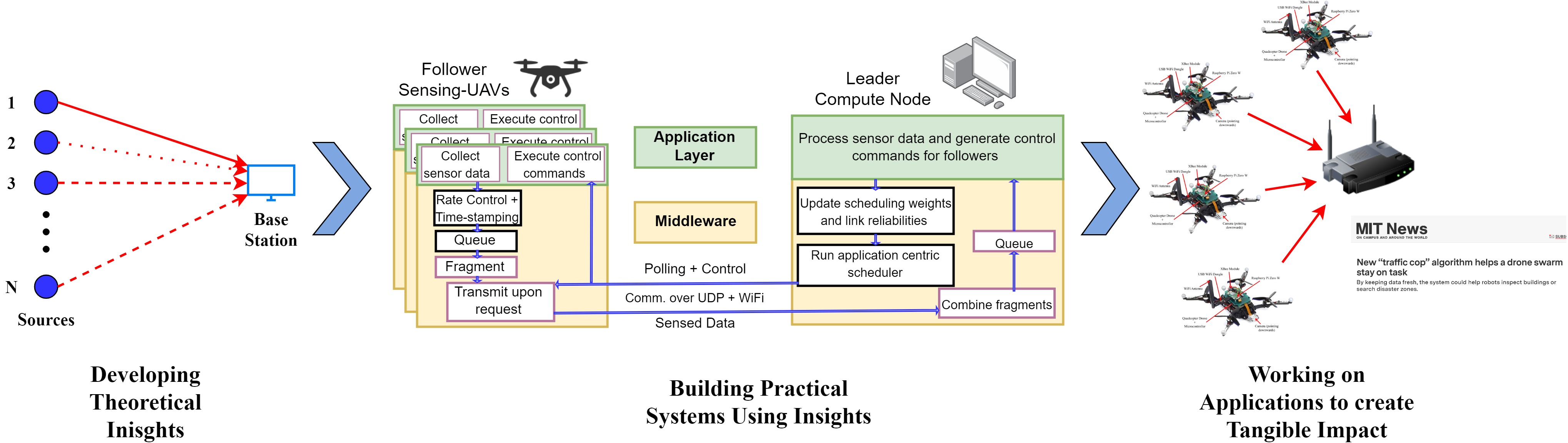
Foundational Theory: We are interested in optimizing communication and networking to build infrastructure of the future and enable networked intelligence at scale. This encompasses analyzing systems ranging from local wireless networks, to next-generation mobile and edge networks, to large-scale cloud infrastructure.
System Design and Implementation: We apply the insights gained from rigorous analysis to the creation of high-performing systems. We often implement our algorithms on software defined radios and UAVs.
Impact: We are driven by the potential of applying our foundational innovations in theory and systems to solve challenging problems, especially in the fields of intelligent robotics and autonomous systems.
 |
Our work has a strong foundation in classical tools and techniques including probability and optimization, modeling wireless systems, graph algorithms, queuing, and control theory as well as tools from machine learning such as multi-armed bandits and online learning. We regularly collaborate with experts in control and robotics as well as cloud networking to directly impact multiple research communities.
Prior to setting up this lab at Purdue, Vishrant (PI of MAIN lab) was at MIT, working with Prof. Eytan Modiano. You can find press coverage of some of his prior work at the following links - MIT News, AeroAstro@MIT, Schwarzman College of Computing MIT, Institute for Data Systems and Society MIT, Wireless Communications Alliance, AI Magazine, Hackster.io, TechXplore, Autonomous Vehicle International, and Quadricottero.
Recent Updates
Sep 2026: Our paper “Communication-Efficient Personalized Adaptation via Federated-Local Model Merging” got accepted to NeurIPS 2026! This work was led by Yinan Zou, along with co-authors Prof. Chris Brinton and Prof. Kamran Shisher.
Aug 2026: We received an NSF VINES Track 2 grant titled “SEA-NET: Scalable Edge Analytics and Networking for Autonomous Maritime Emergency Response”! This is a multi-institution collaborative effort led by Spectronn Inc, along with researchers from Purdue, Georgia Tech and Stevens Institute of Technology.
Apr 2026: Our paper “Timely Trajectory Reconstruction in Finite Buffer Remote Tracking Systems” got accepted to IEEE Transactions on Networking! This work was led by Sunjung Kang, along with co-author Prof. Chris Brinton.
Mar 2026: Our paper “Using Age of Information for Throughput Optimal Spectrum Sharing” got accepted to WiOpt 2026! This work was led by Hongjae Nam, along with co-author Prof. David Love.
Feb 2026: Our paper “Exploring Performance Tradeoffs in Age-Aware Remote Monitoring with Satellites” got accepted to the IEEE Infocom workshop on Age and Semantics of Information 2026! This work was led by Sunjung Kang, along with co-author Prof. Chris Brinton.
Dec 2025: Our paper “AoI-based Scheduling of Correlated Sources for Timely Inference” got accepted to IEEE Transactions on Networking! This work was led by Md. Kamran Shisher, along with co-authors Prof. Mung Chiang and Prof. Chris Brinton.
Apr 2025: Our paper “Optimizing Age of Information in Networks with Large and Small Updates” got accepted to WiOpt 2025! This work was led by Zhuoyi Zhao, along with co-author Prof. Igor Kadota at Northwestern University.
Apr 2025: Our paper “Communication-Efficient Cooperative Localization: A Graph Neural Network Approach” got accepted to WiOpt 2025! This work was led by Yinan Zou, along with co-author Prof. Chris Brinton.
Jan 2025: Our paper “AoI-based Scheduling of Correlated Sources for Timely Inference” got accepted to IEEE ICC 2025! This work was led by Md. Kamran Shisher, along with co-authors Prof. Mung Chiang and Prof. Chris Brinton.
Open Positions
In case you're interested in working on problems at the intersection of communication networks, probabilistic modeling, optimization/control, robotics, and machine learning we are recruiting students for Fall 2027. Send us an email to get in touch!
Research Sponsors
 |